| Assess |
| Risks |
Physical risks |
Risk of halt to operations due to increased
water stress, risk of instability in supply of raw
materials due to ecosystem degradation |
| Transition risk |
Increase in costs accompanying stricter nature-
related regulations (e.g., higher water quality
standards, expansion of biosphere reserves) and
change in product preferences as consumers
become more environmentally aware |
| Reputation risk |
Damage to corporate image due to negative
impact on biodiversity |
| Opportunities |
Development of
new products
and services |
Development of ecosystem-friendly
pharmaceuticals and adoption of production
processes with smaller environmental footprint |
| Efficiency
improvement |
Lowering costs by reducing water usage and
recycling waste |
| Enhancing
brand value |
Enhancing corporate value by contributing to
protection of the natural environment |
Impact on Business Strategy
The identified nature-related risks and opportunities may have the following impacts on our business model and financial planning.
| Research and Development |
We will prioritize investments in the discovery of new pharmaceutical candidates with lower impacts on ecosystems, as well as in research and development of sustainable manufacturing process technologies.
|
| Production |
At manufacturing sites located in water-stressed areas, we will strategically promote the introduction of water recycling systems and the enhancement of water-saving facilities to ensure stable operations.
|
| Procurement |
We will prioritize transactions with suppliers that take biodiversity conservation into consideration and strengthen our standards for sustainable raw material procurement. Through these efforts, we aim to enhance supply chain resilience and reduce the risk of future supply disruptions.
|
| Financial Planning |
We are considering incorporating the necessary funds for nature-related risk response measures (e.g., environmental technology investments and supply chain audits) into our budgets, while reflecting opportunities (e.g., increased sales from environmentally conscious products) in our financial targets.
|
Business Resilience
The impacts of nature-related risks and opportunities on our short-, medium-, and long-term resilience are as follows.
| Short term (up to 3 years) |
We will minimize the risk of temporary operational disruptions caused by water shortages or tighter local environmental regulations through water-saving measures and enhanced wastewater treatment.
|
| Medium term (up to 10 years) |
To address risks associated with the degradation of natural capital within the supply chain, we will maintain a stable supply of raw materials by introducing sustainable procurement policies and securing alternative sources.
|
| Long term (over 10 years) |
In response to broader societal changes resulting from the loss of ecosystem services, we will create environmentally friendly new technologies and products through research and development, and by leading social transformation, we will build a foundation for long-term business growth.
|
The priority location (Priority Location) identified under the TNFD LEAP approach for the Group is our major manufacturing site centered on the Iwaki Factory (Iwaki City, Fukushima Prefecture), which has been designated as the highest-priority area.
Among our directly operated sites, the location with the greatest interface with nature and therefore the highest-priority area to be addressed (Direct Operations):
ASKA Pharmaceutical Iwaki Factory (Iwaki City, Fukushima Prefecture)
This site was selected as our primary manufacturing facility, as it has the largest production volume as well as the highest levels of energy consumption and wastewater discharge.
-
Interface with nature (dependencies and impacts)
Water resources: A large volume of high-quality water is required for pharmaceutical manufacturing processes, including cleaning, cooling, and dissolution of raw materials.
Wastewater: Potential impacts of effluent from manufacturing processes on local water systems (including the Natsui River system and nearby rivers) as well as on the marine environment.
-
Key points of evaluation
Using “WRI Aqueduct (Water Risk Atlas by the World Resources Institute),” the assessment results for water stress (supply–demand pressure) and flood risk in the Iwaki City area of Fukushima Prefecture are as follows.
WRI Aqueduct Assessment Results
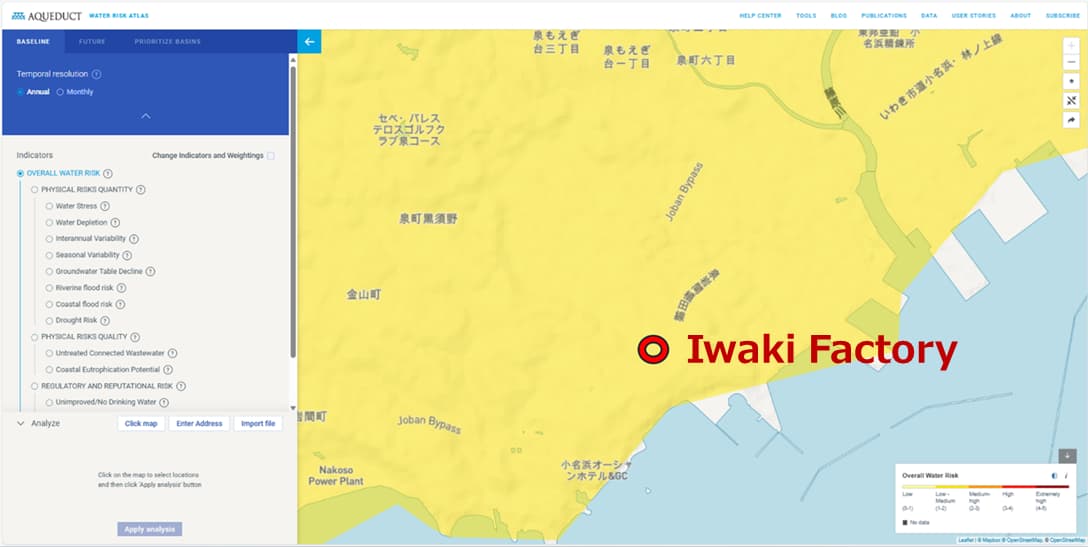
In accordance with the LEAP approach, our Group evaluates the interfaces between our business activities and nature. As a first step, we identified our Iwaki Factory—our core production site with a high dependence on water resources—as a priority location and conducted an evaluation (Evaluate) of water-related risks and impacts on surrounding ecosystems.
(In the future, we will also proceed with confirming overlaps between biodiversity-important areas and upstream supply chain locations, including raw material procurement sites.)
Using the TNFD-recommended tool “ENCORE,” we analyzed the pharmaceutical manufacturing industry’s dependence on natural capital. The results indicated that dependence on “water purification” in direct operations was assessed as “Very High.” This reconfirmed that water management is a critical issue for the Group.
Based on this analysis, we evaluated water stress and flood risk at the location of our main production site, the Iwaki Factory, using “WRI Aqueduct,” as outlined below.
-
Water stress
Assessed as “Low–Medium,” indicating that current water withdrawal risks are within a manageable range.
-
Flood risk
Climate change scenarios project an increase in future risk; therefore,ures within our Business Continuity Plan (BCP).
Furthermore, by integrating the results of these analyses, we recognize that while the pharmaceutical industry has a high dependence on water, our major sites are located in regions with relatively abundant water resources (according to Aqueduct results). However, with regard to water pollution resulting from wastewater discharge—identified as a potential impact by ENCORE—we strictly manage water quality based on voluntary standards that are significantly more stringent than regulatory requirements, thereby contributing to the conservation of local biodiversity.
Building on this water-focused narrative, we will continue to sequentially evaluate other issues identified by ENCORE (such as waste) as challenges for the coming fiscal years.
*1 TNFD Forum:
An international organization established in June 2021 to support discussions within the Taskforce on Nature-related Financial Disclosures (TNFD) as a stakeholder providing expert knowledge, with the aim of developing a framework for corporate risk management and disclosure related to nature.
*2 LEAP Approach:
An assessment methodology developed by the TNFD to evaluate and manage nature-related issues.
It consists of four steps—Locate, Evaluate, Assess, and Prepare—and analysis using this approach covers a substantial portion of the disclosures recommended by the TNFD.
*3 TCFD:
The Task Force on Climate-related Financial Disclosures (TCFD), established by the Financial Stability Board (FSB) at the request of the G20 and chaired by Michael Bloomberg, to consider climate-related disclosures and responses by financial institutions.
*4 ENCORE:
An online tool designed to help assess exposure to nature-related risks and to understand dependencies and impacts on nature.
*This section presents the results of our TNFD-related considerations as of October 2025. Going forward, we will continue to advance our review of risk and impact management, metrics and targets, and other related matters, and disclose updates as appropriate.
Please refer to the following page for details on the ASKA Pharmaceutical Group’s biodiversity initiatives.